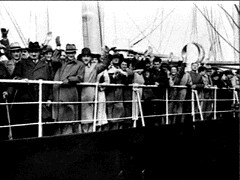
 Fleet's piece set me to thinking about Jewish immigration, and Newfoundland's place in one of the nastiest chapters in modern history. In the years leading up to World War II, ships carrying Jewish refugees were denied landfall in North America and sent back to Europe, often to certain death. (Shown in photo are refugees on board the "St. Louis", which was denied entry by Cuba and the U.S. in 1939.)
Our acceptance of Mr. Barban and a handful of other Jewish immigrants was noble enough, but was it mere tokenism? Did Newfoundland turn away other refugees by the thousand?
I conducted some Internet research into this question. It took some time, but I came up with a fascinating, thoroughly researched article (citing numerous local sources) from the Simon Wiesenthal Centre. It's called "Attempts to Settle Jewish Refugees in Newfoundland and Labrador, 1934-1939", written by Gerhard P. Bassler. You can read it here.
"It may come as a surprise to students of the Holocaust and of Newfoundland history that the Dominion of Newfoundland occupies a place in the history of the Jewish Holocaust," writes Bassler. "Due to its traditionally liberal refugee legislation, low population density, moderate climate, and challenges for immigrants with skills and capital, the island of Newfoundland and the territory of Labrador, which also belonged to the Dominion of Newfoundland, were widely considered a more suitable haven for European refugees than places like Shanghai and the Dominican Republic. In 1934, 1936, and 1939, proposals were advanced for Jewish group settlement, entailing ambitious plans for the economic development of Newfoundland and Labrador. The proposals envisaged spectacular possibilities for the refugees as well as for Newfoundland, and at least one of them came close to fruition. The contemporary public debate on these proposals and on the desirability of admitting Jewish refugees has been forgotten, and the pertinent historical literature contains no reference to it.
"Also unknown, therefore, is the fact that of the thousands of refugees petitioning to enter between 1934 and 1941, the Newfoundland government turned down all but 11 petitions. At the same time, the much smaller, poorer, and far more densely populated Dominican Republic offered sanctuary to 100,000; and the distant, overcrowded, and climatically unsuitable city of Shanghai took 20,000 refugees from Nazi persecution..."
Things were complicated by the fact that Newfoundland was living under Commission of Government at the time, so immigration policy reflected the whims and even prejudices of the appointed commissioners.
"In the 1930s the actions of the Commissioners speak louder than words. Newfoundland and Labrador might have afforded sanctuary to 10,000 or more refugees if the absorptive capacity assigned to the country by settlement experts had become a criterion for admission. Instead, the Commission turned down all the requests and petitions received by and on behalf of more than 12,000 Jewish refugees from Europe. Newfoundland's eight refugee nurses were recruited in London, not because they were refugees, but because they were the only qualified nurses available in 1939 to assume duties in the fishing outports, for which no one else could be found. The search for ways to keep refugees out on grounds other than economic appears to have been one of the chief concerns of the Commissioner for Justice. In their efforts to bar Jewish refugees from the country, the Commissioners looked to Canada as a model. Since British and Dutch farmers continued to be solicited, the systematic exclusion of non-Aryan refugees was clearly discriminatory."
Would things have been different if Newfoundland was an independent country? That is hard to say, and perhaps pointless to debate. However, Newfoundland society has always impressed me as being tolerant and relatively untainted by racism, so I suspect that we would have made a greater effort to save these people. At least, I like to think so.


