Showing posts with label Virginia Tech shootings. Show all posts

Thursday, April 19, 2007

NBC has an attack of good taste

This makes for interesting reading indeed. Brian Williams (right) is Anchor and Managing Editor with NBC News, the network that received the package of text, video and photos from the Virginia Tech killer. In his blog, Williams describes how he and his colleagues wrestled with how to present the shocking material in the package. As it turns out, they used precious little of it, and for all the right reasons.

"A critical piece of information in a huge national news story was dropped on our doorstep," Williams writes. "While I love my work, our task yesterday was extremely unpleasant. Yesterday was an awful day. There was no joy in this for any of us. To the contrary: opening each computer video snippet for the first time was a sickening and harrowing experience - and it's good to know that the worst of them - all now in the hands of investigators - will never see the light of day. As I said on the air last evening: we are aware that this puts words in the mouth of a murderer."

Yes, they did air some of the tape (I would prefer none at all). But Williams' comments are a very good start. Coming from a big American network, it is cause for optimism, in a country where the news business is so extremely competitive and, yes, sensational. One can't help but wonder what would have happened if CNN or Fox News had received the package...

Thanks to Darrell Smith for the link.

The CBC definitely gets it right

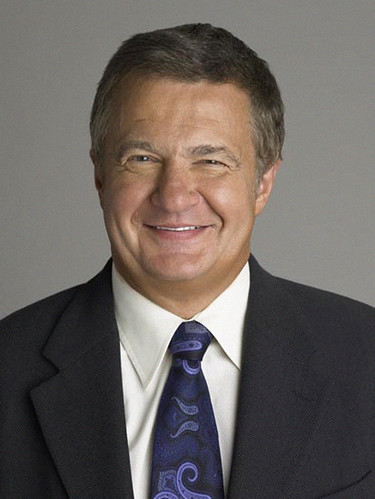
There is a new letter from Tony Burman (left), Editor In Chief of CBC News, posted at the CBC web site. I interviewed Burman two days ago about CBC coverage of the Virginia Tech shootings, and you can read the entry two posts down. His column today offers a thoughtful reflection on how CBC has covered this tragedy. I urge you to read it.

For now, I draw your attention to the postscript that Burman attached to this column, after news of the manifesto package came to light. It's powerful stuff and I have copied it below:

Postscript: On Wednesday afternoon, a few hours after this column was written and posted, NBC News in New York announced it had received in the mail a package from the killer. It contained a compilation of 27 video clips, 43 still photos of him holding guns and a hammer and a largely incoherent 'manifesto' explaining why he had done it. On its evening newscast, NBC ran several minutes of excerpts, and this video has been rebroadcast by a multitude of other networks. At the CBC, we debated the issue throughout the evening and made the decision that we would not broadcast any video or audio of this bizarre collection. On CBC Television, Radio and CBC.ca, we would report the essence of what the killer was saying, but not do what he so clearly hoped all media would do. To decide otherwise - in our view -would be to risk copycat killings. Speaking personally, I have long admired NBC News and I am sure my admiration of their journalists will endure. But I think their handling of these tapes was a mistake. As I watched them last night, sickened as I'm sure most viewers were, I imagined what kind of impact this broadcast would have on similarly deranged people. In horrific but real ways, this is their 15 seconds of fame. I had this awful and sad feeling that there were parents watching these excerpts on NBC who were unaware they they will lose their children in some future copycat killing triggered by these broadcasts.

Today, I received the following internal memo, sent by Burman to all CBC journalists. It reflects nicely the messages contained in Burman's column, and shows that CBC really is walking the talk. I don't publish every internal memo that crosses my desk but have no hesitation in using this one, since it reflects so well on both Burman and his network.

To all CBC news and current affairs staff, and contributors-

As most of you probably know by now, CBC News has decided NOT to broadcast any of the pictures or sound from the collection the Virginia Tech killer sent to NBC News. Our reporting of this should be limited to saying, in words, the essence of his largely incoherent message. It can be accompanied, as it was on last night's National, with a straight head-on freeze frame of his picture, but not those showing him brandishing the guns, hammer, etc.

This applies to all CBC programs and services on Television, Newsworld, Radio and CBC.ca.

Our interest here is to ensure that our coverage of this story does not have the unintended effect of encouraging copycat killings. There's a fuller discussion of this in the CBC.ca 'letter' I posted yesterday on this subject. I urge that you read it. It was written a fews hours before the NBC tapes became known, so I added a 'postscript' this morning at the bottom to deal with this part of the story.

I have attached it here (below). I also suggest you check out the link because the reader responses, which I am certain will grow during the day, are quite illuminating.

LINK

I am sure that you will note that CBC's handling of this issue is quite different from most of the other broadcast and print media, and I hope you're not uncomfortable with this. Canmadians expect a lot from the CBC, and we need to live up to those expectations. There is no place in heaven for journalists who merely follow the pack, and there's no patience anymore for the 'garbage-in/garbage-out' theory of 'news'. We don't simply transmit that which falls on our head: we make editorial
choices every moment of our day, and they need to be the correct ones.

I think that with this decision - as well as last week's handling of the Afghan hostage video, which I wrote about on Monday- - Canadians are telling us that we have made the right call.

Thank you and onward,

Tony


While CBC is taking some brave and principled steps in the right direction, I have come to the conclusion that we need a legislated solution in both Canada and the U.S. There should be an outright ban on the publication of the killer's name, photo or homemade video. We can discuss the contents of the manifesto, as long as we don't mention other killers' names. Just deny them their 15 seconds of fame. I know I am tilting at windmills here, and I don't expect either country to impose such "limits" on freedom of speech. But I feel strongly about this, enough to keep repeating the message. And I ask you: do we really need to know the killer's name and see his face?

Wednesday, April 18, 2007

Surprise, surprise: killer produced manifesto

Man, I hate being right all the time. My post of two days ago described all too accurately what arrived at NBC offices today. It was a package sent by the Virginia Tech killer, containing "a rambling and often-incoherent 1,800-word video manifesto, plus 43 photos, 11 of them showing him aiming handguns at the camera," according to this article in The Globe and Mail. There's not much I can add about this, except that the deranged young man knew his tape would make global headlines.

In his manifesto, the killer actually refers to "martyrs like Eric and Dylan", the teenagers behind the Columbine massacre. I know it's easier said than done, but we need to open a discussion about the idea of somehow not publishing these glorified suicide notes. By doing so, we fulfill the killer's ambition to live in infamy and quite likely inspire other nutbars to try a similar stunt of their own.

The killer actually shot two people at the dorm building before walking to the post office to calmly mail his package, apparently satisfied that his killing spree would proceed as planned. The effort he put into assembling the content of this manifesto, and the fact that he mailed it to media just before the slaughter began, demonstrates that the killings were a twisted public relations device; a way to ensure maximum coverage of his hate-filled and demented world view.

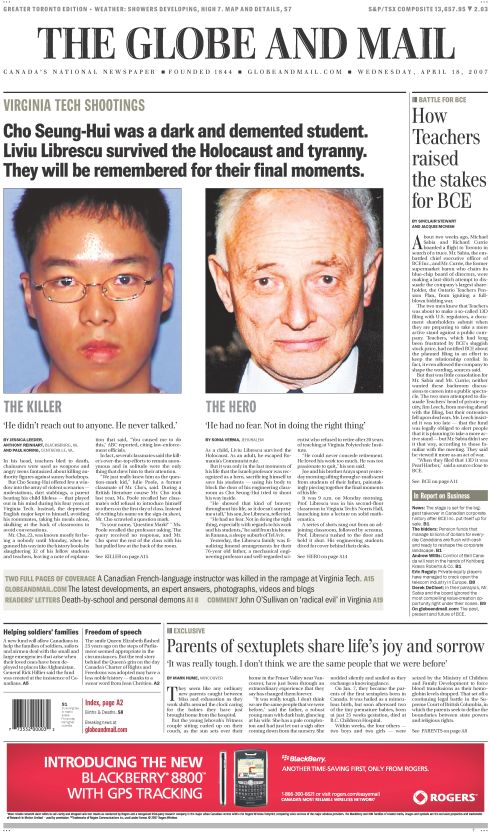
The top headline on page one in the April 18 Globe and Mail had a large picture of the killer and one of the victims. The headline reads: "Cho Seung-Hui was a dark and demented student. Liviu Librescu survived the Holocaust and tyranny. They will be remembered for their final moments."

Don't try this at home, kids. Please.

Tuesday, April 17, 2007

CBC Editor In Chief weighs in on Virginia slayings

Yesterday’s observations on the mass murder at Virginia Tech included a postcript, in which I flagged an editorial by Tony Burman, Editor In Chief of CBC News, which includes news, current affairs and Newsworld. That item prompted an interview with Burman, who is in charge of editorial content on radio, television and the Internet.

In October of 2006, Burman wrote an editorial about the murder of five Amish schoolgirls in Pennsylvania. But the editorial could easily have been written yesterday about the tragic events in Blacksburg, Virginia. For the most part, Burton’s points were similar to those expressed by me in yesterday’s post.

In his editorial, Burman wrote that there were similarities between the Pennsylvania killings and other recent murderous deeds, enough to cause “considerable soul-searching in many newsrooms about what role the media are playing in these incidents.”

Burman quoted Prof. Jordan Peterson, a psychology professor at the University of Toronto and a specialist in personality theory, who believes that some people who commit these acts are seeking “post-crime notoriety.” Jordan told Burman that “idle speculation” by the media has no basis in fact and simply “glorifies” the act.

Peterson’s prescription is for “media to turn off the oxygen” by not naming the killers, or showing their photographs, and not reporting on their writings or motivations.

Interesting words indeed, coming from the most senior journalist in the CBC. After reading Burman’s column, I emailed him a note, asking for an interview. My key question: how have yesterday’s events affected his opinion – and CBC policy – on this issue? To my surprise, he called me the same afternoon.

“It’s such an awful event but one, as you pointed out in your piece, that is becoming so familiar in our culture,” Burman said “Like all news organizations, we’re trying to think through how we handle these things. In terms of your question, regarding what evolution there has been in that awful period since Dawson College and the Amish killings, there are certain things that are different for us at CBC now. Our focus is overwhelmingly on the victims… we’re trying to bring their stories to life in a way that I don’t think we have done in the past.”

So far, Burman said, CBC hasn’t included a picture of the killer on the web site and only “a couple of discrete mentions” have been made of his name.

“I think that was an issue. I know the argument, and you make it very compellingly as does Jordan Peterson and others. But I think that in the fullness of our coverage, we haven’t figured out a rationale for us to go throughout our comprehensive coverage without mentioning a name because I think a lot of people come to us to at least get a sense of who it might be. But I think we are incredibly conscious now of not doing anything inadvertently that tends to glorify him or his actions, or get into the realm of dime-store psychology about his motivation when all of us know so little about what actually went on.”

While I applauded Burman for the wisdom in CBC’s approach, I noted that the big networks in the United States are not about to change their policies anytime soon. It’s a highly competitive business and you can bet that hundreds of reporters are scrambling at this moment to come up with every shred of information they can about the killer.

“It’s interesting because in our daily meeting today I actually made that point,” Burman said. “I said we can’t be like the American networks because they are going to go to town on it, because that is… the competitive edge among all these fighting news channels. There is a lot of rumour out there, and so much stuff that gets circulated, but I think the so-called ‘established media’ has to separate the real from the unreal. I think history will judge us far from perfect on this one, but I think our coverage of this will be far more restrained and hopefully illuminating than perhaps it would have been a year ago.”

I asked Burman to speculate on the chances that his view and that of the CBC might someday gain traction south of the border. However, he is not optimistic on this point.

“I was having this discussion with somebody about gun control. The British coverage of this story has focused on the prevalence of guns, particularly in the Virginia area, and I think that’s a Canadian observation as well. But I am told that the so-called gun issue on a lot of the American networks is not that there should be more gun control, but why weren’t all the students and teachers armed to protect themselves? So I think there is no reason to expect that things are going to change there necessarily… I think this discussion is so incredibly valuable because it’s not the thing that everybody is going to focus on, but in some ways is one of the most important aspects of it.”

One final note: yesterday’s post drew a wave of interest from surfers the world over. It started when someone posted a link to this blog at www.reddit.com, a user driven site wherein visitors browse links and click those that interest them. Links are ranked by visitors and listed in descending order of popularity. For much of the day, the link to this blog held in the top 40, which is something of an achievement given that links are added to the site continuously. At last count, I had received more than 1,000 unique visitors, all originating from reddit.com.

It's safe to say, therefore, that Americans are very interested in this discussion.

Monday, April 16, 2007

Mass killers inspire others to similar acts

Thirty three people dead, at last count. The largest mass murder in American history.

In the deluge of media coverage that will engulf us, following this terrible shooting spree in Virginia, there is one piece of information I don’t want to know.

Please spare me the name of the killer.

You see, I have a theory that the warped minds who commit these crimes do so, in many cases, with one primary motivation: notoriety. They want to be remembered as the bad-ass who went out in a blaze of glory.

It is my firmly held opinion that we shouldn’t give it to them. In mass murder situations like this, the news media should not report the killer’s identity. We should not see pictures of the killer posing in camouflage gear, wearing an AK-47. We don’t need to read the manifesto of murder posted at his web site. By doing so, we fulfill the killer’s wish to live in infamy, while inspiring other like-minded individuals to do the same thing.

As it turns out, I am not alone in this thinking.

“I reached that same conclusion some time ago,” said Elliott Leyton (right), a retired professor of anthropology at Memorial University whose research into mass murder is now applied by law enforcement agencies around the world.

“I think it has been a great mistake but it’s kind of hard to get the press to come on board with that idea. I agree with you that their names and details should be very cautiously handled. The victims should be getting the attention, not the killer. American culture is so saturated with intoxication about violence.”

Leyton’s voice already sounded a little tired when I called him at 7:30 pm. He had been taking calls from media outlets across North America. Before moving on to his next call, Leyton added one more observation, which he will be talking about on The National tonight.

“One of the greatest works of 20th century criminology was Archer and Gartner’s ‘Violence and Crime: A National Perspective’,” Leyton said. “In that book, they showed clearly that, every time there was a major war, there was an effect on the larger culture. People were bombarded with brutalizing images and it kind of validated violence more. Archer and Gartner studied every major war over the last hundred years and noted that, near the end of every war, there was a real surge in excessive violence. You know that the American murder rate dropped in the 90’s, where they weren’t invading anyone at the moment… So when I gave my last lecture at the university last year I said, ‘You watch, if Archer and Gartner are right – and I think they are – we should expect a big increase in homicides as the war grinds on. And it looks like that’s what’s happening. The homicide rates in all the major cities are going away up.”

I can see Leyton’s point. In order to build public support for their foreign conflicts, governments will attempt to glorify the war effort. Certain American networks are keen to play along, playing the ‘shock and awe’ video to its maximum, desensitizing effect. Is it any wonder Americans are killing each other?

Going back to the first point, persuading media to stop reporting names – and every mundane detail of the mass murderer’s life – is easier said than done. The competition to ‘get the story’ is too intense and any attempt at enforcement through legislation would be challenged – probably successfully – as an infringement upon freedom of speech.

In the meantime, one can’t help but wonder how many sick minds are watching this story unfold, fantasizing about stealing dad’s semi-automatic and making some history of their own…

UPDATE: I came up with this theory on my own and was buoyed to learn that Elliott Leyton had similar views, but I am not the first to state this point of view. Check this link for a good editorial summary about the issue, written in 2006 by Tony Burman, Editor In Chief at CBC News.