Death is a spectre that haunts all spot news reporters.
Unscheduled news events are almost always bad news, and reporters are constantly converging on the source of another person's misery.
If you are called upon to cover breaking news, it's just a matter of time before you encounter your first body. It could be a fire, car accident, crime scene, or some other tragedy.
Depending on the circumstances at the scene – the number of casualties, amount of blood and physical trauma, whether or not children are involved, how others are reacting – it can leave an emotional mark on a journalist that remains for a lifetime. Some can shrug it off without too much difficulty, while others take it in and never really let go.
CAR ACCIDENT
Deana Stokes Sullivan, a reporter with The Telegram, has seen her share of death. On several occasions, people she interviewed later passed on, after she had formed a personal bond with them.
Sullivan's first personal encounter with death happened by accident – not assignment – more than 10 years ago. She was driving along the Manuels Access Road through the section known as the "rock cut", when she came upon an accident scene.
"A middle-aged man just minutes ahead of me lost control of his car and flipped over," she recalled. "It looked like he was thrown through the back window. There was glass all around… he was lying on the rocks. The man didn't appear to be in pain and was able to utter a few words, but his body was rather lifeless. I thought about his family, who were likely expecting him home...
"I had a camera with me… but my judgement told me not to use it. I didn't want that to be a lasting memory for the man's family."
Later that night, Sullivan called police and found out that the man had died enroute to the hospital.
“I think over the years reporters are haunted by tragedies they’ve witnessed... The key to coping I believe is to acknowledge that we’re still human, even though we are journalists."
ARROW AIR CRASH
Greg Seaward was a reporter with the Gander Beacon in 1985, the year of the Arrow Air crash. Seaward was on the scene within an hour of the crash, which took 256 lives, the worst air disaster on Canadian soil.
"When we arrived the largest part of the fire had been knocked down," Seaward said. "It was a very cold morning, but it felt warm at the crash site because the ground was still warm. There was a mist hanging around, in addition to the smoke and smell of jet fuel. It was very quiet… the air was thick and warm. It was very tangible. And the first impression I think everyone had was, where is the airplane? The aircraft was disintegrated."
Seaward has vivid memories of the death and devastation he observed that day.
"It was a remarkable scene. There were situations where you might have a very badly burned body, and three feet away another body in perfect condition. There was burning material on top of green trees, and other cases where there were green trees on top of burned bodies. It was just horrendous… a very surreal scene.”
The terrible force of the blast was demonstrated two months later, when a body was found under the roots of a tree. "The tree had been uprooted by the force of the blast, the body flew in under the roots, and then the tree snapped back into place, all in a matter of seconds. It was in the process of cleaning up the site, removing the trees, that they discovered this last body."
Initially, Seaward dealt with the emotional impact of what he had seen by "blocking it out."
"It was a defensive mechanism. You're looking at young people for the most part, going home for Christmas. It was just something that the normal human experience doesn't prepare you for."
Seaward said he still hasn't put the experience completely behind him. "I have spent a lot of time over they years thinking about it, trying to find a place for it in my life," he replied. "Obviously I've stayed very close to that particular event over the years, and followed what the (bereaved) family members were doing. You know, a grandchild was born, a son or daughter graduated from university, and I think it helped to watch those people getting on with their lives."
Seaward paused again, then said, "I'm still struggling with the personal closure question… It's something I can't put my finger on. I guess you pick up your life and carry on."
Just a month ago, Seaward was at a meeting when he heard sirens, and saw fire trucks pass by. "I got that feeling in the pit of my stomach again. Just the sight of what appeared to be the entire fleet on the move… it stopped me in my tracks for a moment."
SAMANTHA WALSH
The entire province was held spellbound when 13-year-old Samantha Walsh went missing in Fleur de Lys. Few people were more absorbed in the story than Kevin Harvey, the video-journalist with CBC TV, who said it was the "most difficult" event he's ever covered.
Harvey was immediately welcomed into the Walsh household, where Samantha’s parents, George and Millie Walsh, opened their hearts to him. “They wanted to get the message out to anyone who might have seen Samantha, and they thought I was the person who could do that… I had wide open access to this family, who were going through this traumatic experience, and it was just incredible.”
During that first interview, Millie Walsh broke down and cried, “Someone’s took her, I just know it.” Her pain was heart-rending for all who witnessed it, including Harvey.
“I was sitting in this child’s bedroom holding the camera, and I was just shaking, just trembling,” said Harvey, who had a 13-year-old daughter of his own at home. “I didn’t know what to say or do to comfort her… Millie knew that Samantha wasn’t a runaway, and that something was wrong right from that first night.”
Over the next week or so, Harvey saw so many photographs and heard so many stories about young Samantha, he felt as if he knew her. So the shock was terrible when he got the call that Samantha's body had been found, almost two weeks after she went missing. “It was just a stone cold shiver that went through me… I went into the town and there was a lot of activity, the police were there, and I knew it was for real… So I had no sleep at all that night. None whatsoever.”
That night was the first time in almost two weeks that someone made a sneering comment about the media. "It was like, 'Look at 'em, look, that media crowd'… I think it was the anger that had built up. I think they needed somebody to yell at, and I didn't mind… I think you walk a fine line when doing stories like this."
Harvey wasn't there for the funeral. He left earlier that day for Corner Brook to begin editing that day's piece. "I was editing my own stuff, and then Doug (Greer) brought in the funeral footage… and her casket leaving the church. So I said, 'Doug can you leave?' When he did, I just broke down crying, while doing the last edit on that story. And I sat alone in that room for another 15 minutes or so after the item was finished."
The item Harvey filed that day was powerful indeed. It began typically enough, with a minute or so of voice-overs. But then it cut to the recording of Samantha's angelic voice, singing "Saltwater Joys", laid over family photos and images from the funeral. Samantha was singing her own eulogy, her last goodbye, and it was touching indeed.
"There are times when a reporter has to shut up, and I think this was one of those times," Harvey said. "What could I have said that would add anything to this?"
OCEAN RANGER
VOCM News Director Gerry Phelan had a unique encounter with mortality. The year was 1982 and the Ocean Ranger had just been lost.
“I was at the Holiday Inn when they released the names of the 84 men who died,” said Phelan, who was a young radio reporter with VOCM. “My job was to read those names live, onto the air, which I did. I was trying to keep a tone of voice that showed respect for the victims, when suddenly I realized that I knew some of the people whose names I was reading. They were friends of friends, or people I had gone to school with. I finished reading the names, but was almost overwhelmed with emotion. It really struck home what this meant. These were real people, and it is so easy to forget that in this business… When I played back the tape later, I could hear how my tone was changing. I get goosebumps talking about it even now.”
A man of strong spiritual conviction, Phelan wrestles with every story that involves tragedy. “Before I read any story, I ask myself ‘who does it hurt?’ This is my 25th year in this racket, and every single time I read a story about a fatality I ask myself that question. Some say you get immune to it but you don’t. At least, I don’t.”
While working as a journalist, my only encounter with death also involved the Ocean Ranger. I was working with The Newfoundland Herald at the time, and knew several of the victims personally. One of them, Greg Tiller, had written a startling poem that actually foretold the disaster. I wanted to publish that poem as a tribute to the young man, but the only way to get it was ask his family, who I had never met.
This was just a couple of days after the incident, and the loss would still be an open wound for them. I remember sitting in the car at the end of their driveway for quite some time, steeling my nerve to knock on the door. When I did, a man, clearly distraught, opened the door.
" I’m a reporter with the Herald," I stammered. "I'm very sorry about your loss. I knew your son. And I know he wrote a powerful poem about the Ocean Ranger. Would you mind if I published it?"
He just looked at me, not answering right away. Behind him, I could see one woman holding up another woman, as they walked slowly down the hall. Their grief was palpable. It flowed out the door with the weight of thick molasses. This family had just had its heart ripped out… and I was intruding on their pain, asking for a silly poem. Finally, the man said, "Sorry… not now," and closed the door.
I got out of there as fast as possible, ashamed of what I had done.
Unlike many of my colleagues, I wasn’t scarred by this little brush with death. But I did learn that, sometimes, journalism hurts.
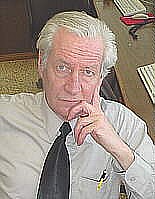 He was the only working journalist to cover all nine provincial premiers. And this afternoon (May 22), it all came to an end. Veteran broadcaster Scott Chafe passed away at the age of 62, after a brief battle with lung cancer.
  We are mourning one of our own today. A man who can be called THE senior journalist in this province, has passed away. VOCM's Scott Chafe was 62.


