Showing posts with label ken meeker. Show all posts

Monday, April 2, 2007

Ken Meeker and his adventures at the front

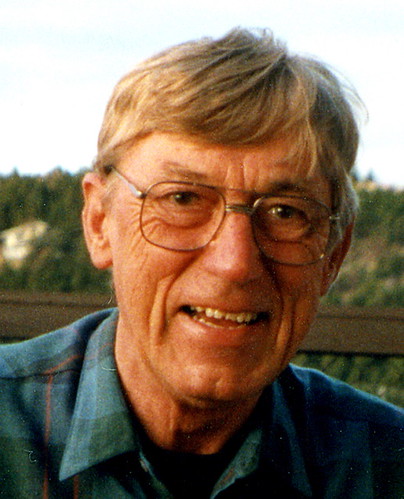
I was but a youngster when the anti-seal hunt movement got its start, but my Dad, Ken Meeker, was in full career flight and covering the story as a reporter with CBC Here & Now. He is and will always be Dad, but for now I will call him Ken. Knowing that he is always good for a story – and having already heard some good ones over the supper table – I interviewed Ken about the seal hunt.

He went to the front twice, in 1977 and ’78, when St. Anthony was alive with crowds of protesters, fishermen, DFO types, police, media and a few movie stars as well. He was there when Brigit Bardot showed up, propelling the seal hunt to international headlines, but didn’t see a lot of the French bombshell.

“I saw her when she arrived in St. Anthony, but never got too close to her. They snuck her up to the ice on their own helicopters and had her picture taken with a seal, then brought her back to Blanc Sablon on the Quebec side. The camera crew went over there to cover her news conference but I didn’t bother going – I was busy trying to get my film out of there and back to St. John’s.”

Ken had a closer encounter with actress Pamela Sue Martin, star of the Nancy Drew Mysteries and another famous protester to visit the front. He interviewed the starlet one particularly cold day.

“We were interviewing Pamela Sue down by the waterfront and it was a bright clear day but very cold. I was shooting my own movies of her, and got my footage of sound man Kevin Hanlon blushing as he reached up underneath her sweater to put the microphone on! I always carried these two little airline bottles of rum in my parka pocket. It got me out of jams and came in useful many times. Pamela Sue was obviously very cold so, after the interview was over, I pulled out the little bottle and asked if she would like a drink. She said ‘Oh yes, would I!’ and I got a shot of her sipping down the little airline bottle of rum. She drank it straight.”

These days, such footage would have been a big part of the story. But tabloid TV didn’t exist back then, and Ken was too courteous to use the footage on the air.

But Ken’s most interesting celebrity encounter happened that same year, with two American congressmen – Leo Ryan and James Jeffords – who were in St. Anthony to observe the hunt.

“They arrived in the late afternoon,” Ken said. “I had sent the camera man out to get their arrival on film, and when he came back he said they were beat out. They had been on four different flights just to get there from where they started. When they got to the motel, whatever room they had booked wasn’t ready and I just happened to be walking through the lobby, so I said ‘Hey guys, my room is right there and I’m going down to get supper now, so go in and get yourselves settled down, get sorted out and there’s a bottle of Bacardi on the table, and when your room is ready, fine.’ They said thanks very much and went in. They were still there when I got back after supper. Their room still wasn’t ready for them because the place was really blocked off. So I went in and spent some time talking with them, and they knocked off three quarters of the bottle of Bacardi. Jackie Spiers was there, his Executive Assistant, and she promised to replace the bottle – but they never did.”

Just a few months later, congressman Leo Ryan was in Jonestown, Guyana to investigate Jim Jones and his Peoples Temple religious cult. Ryan’s visit was likely the spark that caused Jones to explode and order the mass suicide and murder of 913 people. Leo Ryan was shot and killed while trying to board his airplane. Jackie Spiers was also shot, but survived by ‘playing dead’.

The protesters were well known for their propaganda, Ken said, but the folks at Fisheries and Oceans were also capable of stretching the truth a little.

“The DFO people told us that as soon as you approach these seals, the mothers would abandon their pups and go down through a hole in the ice. They let us go out on the ice a day before the hunt opened, and I had my camera with me. There was a little seal pup and we were shooting film of this great big mother harp seal. But on the way out there in the helicopter, it was so damn cold and my hands so numb that I dropped the camera on the floor and screwed up my vewfinder. So I could just see shapes but no detail. I was down on my knees shooting this mother harp seal and all of a sudden the guys started yelling ‘Meeker look out’ and here she was coming straight at me. And I got it on film, for a few seconds, before I got the hell out of there. She was huge and she was coming after me. Discretion was the better part of being a good cameraman, believe me!”

One of the most memorable encounters between sealers and protesters happened at the Loon Motel, where protest leader Brian Davies was stationed with a small squadron of helicopters.

“On this day, about 50 or 60 fishermen tried to block Brian Davies from getting to his helicopters. In fact, a couple of them threw snowballs at Davies on the way out. The Mounties were there, and so were two of the American networks, as well as the French, German and other networks. Two Mounties would grab one fishermen and carry him off. The Mounties were mostly from local detachments and knew each other, so when they carried them away they were talking to each other in a friendly way. And the Americans were shaking their heads. Later on, the Americans were telling me that they were waiting for the blood to be spilled. In the States, they said, the truncheons would have been out.”

This blog gives me a great excuse to call my dad at random and get him reminiscing about major stories he has covered, and the people he has interviewed. Stay tuned for more. And if you’d like to watch some fascinating footage from that same Pamela Sue Martin and Leo Ryan trip, visit the CBC archive.

Saturday, February 10, 2007

Toxic headlines are making me ill (January 2004)

Note from author: This column was revised and updated for publication in the Spring 2005 issue of Media Magazine, the official publication of the Canadian Association of Journalists.


Journalists will usually react with skepticism to any controversial release, digging deeper, asking tough questions and refusing to conform to the newsmaker’s agenda. There is, however, at least one exception. When it comes to scientific studies that affect our health, media will sometimes amplify and exaggerate the seriousness of the ‘threat’.

This is no idle accusation. It’s a conclusion I’ve drawn from years of media observation. I write a media analysis column for The Express newspaper in Newfoundland and, last year, did some research to substantiate my theory.

My conclusion is that, when it comes to health stories, even the most respected news outlets will not read the fine print or delve into the science, rushing to conclusions that are sensational, not necessarily factual.

MAD COW UNEASE

The crisis over mad cow disease has been devastating Canadian cattle farmers since the first outbreak in May of 2003. It continues to generate above-the-fold headlines, following the recent court decision in Montana which blocks the reopening of the U.S. border to Canadian beef.

Yes, the story is significant. But it needn’t have dealt such a terrible blow to our cattle farming industry. How many news items have clearly explained the real health threat of mad cow disease? How many have compared our situation with that of the United Kingdom?

Reporters in Canada were quick to report on the crisis as its ramifications rippled into external markets, but they failed to offer balancing information that might have tempered the situation. Two years later, I still haven’t seen an effective reality check from media. If anything, they’ve been fanning the flames of confusion and fear around this story.

Reporters might have explained that, in the United Kingdom, cattle were fed animal carcasses infected with bovine spongiform encephalopathy (BSE) or mad cow disease for years. Estimates are that anywhere from 50,000 to one million infected cows were consumed in the UK. So far, more than 100 people have died from the disease (though more cases are bound to surface). Given the size of the UK population and the apparently widepsread consumption of the BSE virus, this is a relatively small number. (U.K. residents might better focus their concerns on second hand cigarette smoke, which kills more than 11,000 people per year in that country, according to a British Medical Journal study.)

In Canada, we have learned from the UK experience. We have much greater awareness, more stringent health and safety controls on beef, and four known cases of BSE in cows. As far as we know, no infected meat has been consumed in Canada or the U.S. No one has contracted the human variant of this disease, and the real danger to consumers is practically nil.

I am aware that this story is not exclusively about health concerns. The protectionist agenda of the American cattle farmers is also a factor. Which reinforces the need for greater clarity around the actual health threat posed by BSE.

I am not suggesting that reporters should build in such balancing information in their early news coverage. When I worked as a reporter, if someone had suggested I include "softening" information in breaking stories I would have told them to take a hike. However, this type of information does have a place as a story unfolds, when the public is looking for background information to better understand the issue.

SOMETHING FISHY

The headlines were pretty scary: ‘Eating salmon may pose health risks;’ ‘Farmed salmon laced with toxins;’ ‘Scare over farmed salmon safety’.

These headlines were collected on the Internet from news sources around the world, reacting to a 2004 study in the journal ‘Science’ about toxin levels in farmed salmon.

The report was reasonably credible in its research, at least on first glance. However, the story it generated contained a major flaw in logic.

Articles in both ‘The Globe and Mail’ and on the BBC News web site took a similar approach to this story. In the top paragraphs, they summarized the findings as alarmingly as possible.

“Farm-raised Atlantic salmon… are so laced with PCBs and other pollutants that they should be eaten only infrequently,” said the Globe in its lead sentence.

Then they brought in opposing viewpoints from health officials and the salmon farming industry, but they came across as defensive and self-serving. (Could it have sounded any other way, given the scandalous tone of the lead sentence?)

The truly telling information came out in the bottom half of The Globe piece. Farmed salmon had up to 50 parts per billion (ppb) of PCBs, which is well below Canadian federal guidelines of 2,000 ppb. However, one of the report authors suggested that this standard, developed in the 1970s, is out of date and should be reduced to 50 ppb. Which means that the highest concentration of PCBs found in this study would meet the proposed, more stringent regulations – information that renders the entire story almost completely pointless.

The reporters in this case did manage to slip in key balancing information, even if it might best be described as ‘nullifying’ information. And not before playing the most sensational allegations first and loudest, thereby whipping consumers into a frenzy and possibly causing major damage to the fish farming industry.

If a government department had announced a new development scheme that contained an equivalent flaw in logic, the media would catch it and make this gaffe the focus of their story. But when our health is at issue, they set aside rational thinking and run shrieking onto the airwaves and into print.

I invited The Globe and Mail via email to respond to this item, but received no reply. That said, The Globe is not the only offender here. Pretty much every major news outlet played this story the same way. And the hysteria created by this coverage is being perpetuated on the Internet, as a quick Google search for “toxins farmed salmon” will show.

ACRIMONY OVER ACRYLAMIDES

In 2002, we had another major health scare in the form of acrylamides, which are chemicals reported to cause cancer in animals. Researchers in Sweden found acrylamides in fried foods, like french fries, and even baked foods such as bread and cereal. The acrylamide story received extensive coverage in this country.

In January 2003, CBC TV’s “Marketplace” reported that Health Canada was suppressing test information about acrylamide levels in foods, whereas governments in Sweden, Germany and Norway were issuing all sorts of precautions.

“Marketplace has learned… that our government is keeping information from you,” said reporter Wendy Mesley, who revealed that Health Canada was indeed not telling us about test results they had conducted on our food. And if acrylamides were proven to be dangerous to humans, it would have been a valid story.

But I was always suspicious about this one. Mankind has been eating bread and cereal products in large quantities for hundreds of years; why haven’t we noticed a cancer correlation?

I went to the CBC “Marketplace” web site and found an entire section devoted to this story. After some mining, I found what I was looking for under the heading ‘Is acrylamide in food a threat to our health?’

According to a scientist with Health Canada, “the amounts of acrylamide humans consume on a daily basis is slightly over 1/100th of 1 per cent of the dose, adjusted for body weight, that gave cancer to half of an exposed group of rats.”

By my calculation, this means we would need to consume 10,000 times more acrylamide than we do right now, in order to duplicate the experience of those unfortunate rats. If Marketplace had seriously considered this information, they might have concluded that Health Canada was right not to panic about this bogus health crisis.

I invited Marketplace via email to respond, but received no reply.

A LONG HISTORY

While doing Internet research for this article, I found a fascinating essay by David Ropeik, writing for CommonWealth magazine out of Massachusetts. (The magazine appears credible and free of any overt agenda.) Ropeik suggests that editors and reporters develop stories based on “risk perception”; a combination of value-charged factors that trigger audience reaction.

“In short, stories about health risks sell,” Ropeik writes. “Newspaper editors and broadcast news directors want stories the public will notice, stories that sell papers and boost ratings. And reporters — who aren't concerned with corporate profits but are interested in their work getting the widest possible audience — highlight the aspects of their stories that seem particularly frightening.”

To read the full article, visit http://www.massinc.org/commonwealth/mass_media.htm. (Update: This link is no longer working, and the site now has a subscription fee.)

The media health scare phenomenon is nothing new. I learned to be cynical about it at an early age from watching my father, Ken Meeker, when he worked as a broadcast journalist. I was just 12 years old in 1969, when the U.S. government banned cyclamates because they caused cancer in eight out of 240 rats that were fed the chemical.

My father covered this story but, to his credit, didn't take the scaremonger approach. He debunked the story by revealing that the lab rats ingested cyclamates at levels equivalent to humans drinking 350 cans of diet soda per day.

Is this starting to sound familiar?

I am not saying that reporters always over-react to such stories. Sometimes, they nip them in the bud. For example, subsequent health scares about other artificial sweeteners, most notably Aspartame, have not been amplified by media (despite falsehoods that persist on the Internet).

And sometimes, it's okay to panic. The media frenzy serves a useful purpose when the threat is real, or when public awareness is necessary. For instance, all the publicity given to SARS, frantic as it was, helped keep that disease from spreading.

What we need, however, are reporters and editors who look more diligently into the science before creating those alarming, sensational headlines.

Now, pass the salmon and french fries please.