Thursday, March 8, 2007

A little-known chapter in our history

Wednesday evening's edition of CBC's Here & Now featured a touching, eye-opening segment of 'The Finest Kind', by Deanne Fleet. It was the story of Andreas Barban (and his wife), Jewish immigrants who were accepted into Newfoundland in 1947, having escaped from Germany to the Far East. I had certainly heard of Barban, who died in 1993, but - like many others, I suspect - had no idea about the impact he had on the social and cultural fabric of this province. Frankly, if not for this item, I never would have known so kudos to Deanne Fleet for bringing it to our attention. (Why it aired at the very end of the newscast I don't know; it certainly deserved to be higher than that in the lineup.)

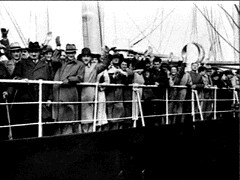
Fleet's piece set me to thinking about Jewish immigration, and Newfoundland's place in one of the nastiest chapters in modern history. In the years leading up to World War II, ships carrying Jewish refugees were denied landfall in North America and sent back to Europe, often to certain death. (Shown in photo are refugees on board the "St. Louis", which was denied entry by Cuba and the U.S. in 1939.)

Our acceptance of Mr. Barban and a handful of other Jewish immigrants was noble enough, but was it mere tokenism? Did Newfoundland turn away other refugees by the thousand?

I conducted some Internet research into this question. It took some time, but I came up with a fascinating, thoroughly researched article (citing numerous local sources) from the Simon Wiesenthal Centre. It's called "Attempts to Settle Jewish Refugees in Newfoundland and Labrador, 1934-1939", written by Gerhard P. Bassler. You can read it here.

"It may come as a surprise to students of the Holocaust and of Newfoundland history that the Dominion of Newfoundland occupies a place in the history of the Jewish Holocaust," writes Bassler. "Due to its traditionally liberal refugee legislation, low population density, moderate climate, and challenges for immigrants with skills and capital, the island of Newfoundland and the territory of Labrador, which also belonged to the Dominion of Newfoundland, were widely considered a more suitable haven for European refugees than places like Shanghai and the Dominican Republic. In 1934, 1936, and 1939, proposals were advanced for Jewish group settlement, entailing ambitious plans for the economic development of Newfoundland and Labrador. The proposals envisaged spectacular possibilities for the refugees as well as for Newfoundland, and at least one of them came close to fruition. The contemporary public debate on these proposals and on the desirability of admitting Jewish refugees has been forgotten, and the pertinent historical literature contains no reference to it.

"Also unknown, therefore, is the fact that of the thousands of refugees petitioning to enter between 1934 and 1941, the Newfoundland government turned down all but 11 petitions. At the same time, the much smaller, poorer, and far more densely populated Dominican Republic offered sanctuary to 100,000; and the distant, overcrowded, and climatically unsuitable city of Shanghai took 20,000 refugees from Nazi persecution..."

Things were complicated by the fact that Newfoundland was living under Commission of Government at the time, so immigration policy reflected the whims and even prejudices of the appointed commissioners.

"In the 1930s the actions of the Commissioners speak louder than words. Newfoundland and Labrador might have afforded sanctuary to 10,000 or more refugees if the absorptive capacity assigned to the country by settlement experts had become a criterion for admission. Instead, the Commission turned down all the requests and petitions received by and on behalf of more than 12,000 Jewish refugees from Europe. Newfoundland's eight refugee nurses were recruited in London, not because they were refugees, but because they were the only qualified nurses available in 1939 to assume duties in the fishing outports, for which no one else could be found. The search for ways to keep refugees out on grounds other than economic appears to have been one of the chief concerns of the Commissioner for Justice. In their efforts to bar Jewish refugees from the country, the Commissioners looked to Canada as a model. Since British and Dutch farmers continued to be solicited, the systematic exclusion of non-Aryan refugees was clearly discriminatory."

Would things have been different if Newfoundland was an independent country? That is hard to say, and perhaps pointless to debate. However, Newfoundland society has always impressed me as being tolerant and relatively untainted by racism, so I suspect that we would have made a greater effort to save these people. At least, I like to think so.

He won't be a free agent for long


Once again, we are all indebted to George Murphy. The lineups were long last night as people queued to fill their tanks, alerted by Murphy to an imminent increase in the price of gasoline.

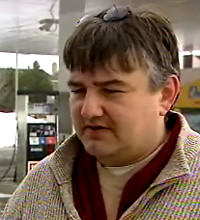
Murphy (at right, CBC photo) warned us that the price would increase by at least 7 cents per litre, and the actual increase was close to 8 cents. For drivers able to get out last night, especially with larger vehicles, the savings were substantial indeed.

No wonder then that, when George Murphy talks, people listen.

It’s amazing that George, a taxi driver with no training in economics, is able to duplicate with uncanny accuracy the work of the province’s Petroleum Pricing Office, working from the basement of his home with nothing more than a computer and an Internet connection.

Equally impressive are Murphy’s public communication skills. Prior to his volunteer work on oil and gas pricing, George had no training or experience in communications. He is now one of the province’s best-known and most respected public policy advocates. He is quick on his feet, talks with confidence and handles media interviews in a friendly, forthright manner. When he talks, people listen. Reporters are quick to answer or return his calls. People trust him.

George Murphy has what I like to call ‘trust equity’ with the public. Combine that with his great media relationships and you have probably the most effective spokesperson in the province.

As noted above, George is driving a cab for a living. There’s nothing wrong with that – it’s a noble occupation for sure – but Murphy is certainly under-employed for his skills and status within the community.

That’s about to change. Murphy is switching lanes onto an entirely new career path, having just completed a public relations program at CompuCollege. He is now qualified to work in communications and has already performed some contract work for clients.

Any company or organization that would like to put a consistent public face on its public and community relations should give George Murphy careful consideration. Heck, they should grab him while they can! I predict that he won’t be a free agent for much longer…

Wednesday, March 7, 2007

Time vs. Maclean's: and the winner is...

A piece of junk mail caught my eye this week; an offer to subscribe to the Canadian edition of Time magazine. I am an avid reader of Maclean’s Magazine, so this piqued my curiosity. Which is the better magazine for the money?

Hands down, Time is cheaper. They are offering me 56 issues for $30 and two years for $35. One year of Maclean’s will set me back $57 and two years will cost $100, more than triple the cost of Time. However, that’s where Time’s advantage ends.

Unless you have an affinity for superficial coverage of American news and don’t give a fiddler’s fart about what’s going on in Canada, Time is a waste of paper. The Canadian edition is a misnomer, since the two recent issues I examined had almost no Canadian content. There was one article in the January 1 edition about the Canadian Man of the Year (Stephen Harper) and the February 12 issue was Canuck-free. Calling the magazine ‘Canadian’ borders on deception.

MacLean’s, on the other hand, is a remarkably good magazine. I have been a subscriber for more than 10 years, and have seen the magazine evolve from a dry, dust-gathering fixture at the dentist’s office to a vibrant and challenging read. When editor Anthony Wilson-Smith left in 2005, to be replaced by Ken Whyte, former editor of the right-leaning National Post, there was concern that the magazine would tip too far to the right. While this influence is there, on the editorial page and in the appointment of former National Post writers – such as Mark Steyn – it is clear that Whyte’s priority, first and foremost, is to create a quality magazine packed with provocative reading.

Maclean’s has abandoned its dry weekly news wrap-up format, in favour of a more featurish, analytical and subjective writing style (which is essential, since weekly glossies cannot compete with daily newspapers and electronic media for straight news coverage). The magazine has also gotten bigger, increasing content by 30% and more.

My favorite columnists in Maclean’s are Paul Wells (penetrating political commentary), Andrew Potter (intelligent, left leaning) and Scott Feschuk (the funniest man on earth). The arts and entertainment section is bigger and better, and the writing throughout is always good and often excellent. If you haven’t read Maclean’s Magazine in a few years, I strongly recommend you pick up a copy. You will not be disappointed. (Hint: it is much cheaper to subscribe.)

Above all, don’t waste your money on Time magazine!

Tuesday, March 6, 2007

More questionable marketing stunts

Hot on the heels of that disastrous promotional stunt in Boston, in which blinking electronic packages – planted to promote a cartoon series – stirred fears of terrorist bombs, come two more ‘what were they thinking’ moments in marketing.

Still in Boston, Cadbury Schweppes got into hot water when it sent people on a treasure hunt, looking for a buried coin that was worth $1.5 million to the finder. What raised eyebrows in this instance was the location of the treasure hunt: the coin was buried in Boston’s 350-year-old Granary Burying Ground, resting place of John Hancock, Paul Revere, Samuel Adams and other famous U.S. citizens.

According to a contrite Cadbury spokesperson, the historic cemetery “was not an appropriate place to bury a coin. It was poor judgment and we have apologized to the authorities. No damage was done to the graves.”

Just before that, the folks at KFC caused a holy ruckus with the launch of their new Fish Snacker sandwich, which the company says is ideal for “American Catholics who want to observe Lenten season traditions” while leading busy lifestyles. Gregg Dedrick, the President of KFC, went straight to the top in searching for a product endorsement.

“The company has turned to Pope Benedict XVI, beseeching him to bestow his Papal blessing for this innovative new menu item,” KFC said in a press release. “Vatican officials confirmed they received KFC's request, and the company is hopeful to get the Pope's blessing this Lenten season.”

If this was a joke, it didn’t ring true and the stunt gave heartburn to many American Catholics. As far as I can tell, the company still hasn’t issued an apology.

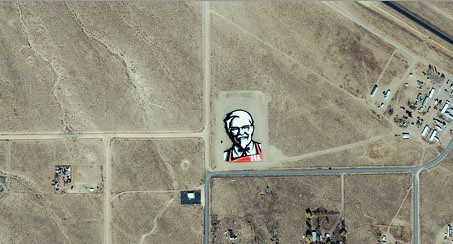
Still with KFC, I wonder if the company was trying to appeal to a higher power with another promo stunt, the recent unveiling of what the company says is the “world’s first brand visible from space" (image below).

Yes, the Colonel’s face can now be seen by extraterrestrials, hungry perhaps for some unidentified frying objects. The logo covers an area of 87,500 square feet in the Nevada desert, also known as the UFO capital of the world. (The logo is much larger than a 75 X 110 foot replica of a Maxim magazine cover that was assembled last year, also in Nevada.)

And then, in the midst of all these marketing public relations ‘wins’, KFC gets stuck with this stinker of a video clip on You-Tube, exposing a rat infestation at a KFC/Taco Bell in New York. Which goes to show that there is indeed such a thing as 'bad publicity'.

Monday, March 5, 2007

Avalon caribou are safe for now

The CBC Radio Morning Show had a great follow this morning (Monday) on an item it aired last Friday, about a grass roots movement to open up the Avalon Wilderness Reserve to snowmobile traffic. The small group of retired people behind the movement, who seem credible enough, say they respect nature and will behave responsibly. They also said the Avalon caribou herd that the reserve is intended to protect has dwindled from thousands of animals to hundreds, and that there were none left in their neck of the woods anyway.

That item resulted in a flood of calls from listeners, every one voicing opposition in a most articulate way to changing the regulations. This was followed by an interview with wildlife biologist Dennis Minty, who presented a persuasive case against opening the reserve to the machines. His key point: years ago, caribou numbers in the reserve had declined to a few hundred animals, and the reserve had been instrumental in bringing them back from the brink. Opening it up now can only cause harm to the herd, which has been decimated by a persistent outbreak of brainworm.

Host Jeff Gilhooly also made a good point: the proponents of this notion may well be responsible, but it would open up the area to "cowboys" with less noble intentions.

The environment minister is going to be interviewed on Tuesday, but it's safe to say that this issue is already dead in the water... or should that be lost in the wilderness?

Friday, March 2, 2007

Cochrane's speech had quite an impact

The full text of David Cochrane’s speech to the St. John’s Board of Trade, which you can read in its entirety two posts down, has generated a lot of discussion over the last two days.

My blog is less than a month old so, up to now, I was getting about two hundred hits per day. Word of mouth is an amazing thing because, soon after the post appeared, I was getting almost a hundred hits per hour! The hits are still coming at a pretty steady pace, so I know that Cochrane’s speech is having an impact.

Thanks for this must go to Ed Hollett, Simon Lono, Craig Welsh and the six or seven others who flagged the Cochrane speech in their blogs.

The entry seems to have touched a nerve, because the majority of comments (on this blog and elsewhere) applaud Cochrane for expressing his views. Naturally, some people didn’t agree, and that’s fine too, though those people who accused Cochrane of political bias or hidden agenda did not get the point.

What Cochrane advocates is open discussion and debate of the issues; an environment where questioning the government’s approach is not equated with a lack of patriotism. This is essential to any healthy democracy.

I am a big fan of disclosure so, for those who don’t know me, it is no secret that I do a fair bit of consulting work for the oil and gas industry. That said, I am not a mouthpiece for the industry. I am at a point in my career where clients pay for my ideas and advice, and respect my counsel. They do not expect me to shill for them. My opinions – which will gradually unfold in the weeks and months ahead – are honestly held and based on a career that includes 12 years of journalism and 15 years in communications, working with technology, mining and oil and gas companies, as well as public sector and not-for-profit clients.

My political affiliations? I have none to any particular party. In the federal election of 2006, I volunteered to handle media for Liberal candidate Siobhan Coady, but this does not make me a Liberal. I simply have a great deal of respect for the candidate. In the last provincial election, I voted PC, because I liked Danny’s business background and believed that he could get the best deal for the province in resource development. Where I stand on that is a subject for another day…

Thursday, March 1, 2007

Hickey's defamation suit is proceeding

So, the comedy begins. I see that John Hickey filed his defamation suit today against former premier Roger Grimes. You can read about it in this CBC story.

To add to the joke, Grimes has now threatened to file a suit against Premier Danny Williams, for supposedly putting words in Grimes mouth that the erstwhile premier did not utter.

As noted in a previous post, this is a tactical error on Hickey’s behalf (and Williams too, if indeed he is pulling the strings here). The media is gleefully going to follow this story while it plays itself out, and there will be close scrutiny not only about what Grimes said, but also what Hickey did to prompt the remarks.

Let’s put this in some context. I have been filing expense and travel claims for various employers since 1984. Not once – not a single time – have I billed twice for any of my expenses. And I suck at math!

Once or twice, I found a Visa slip and wondered if it had been claimed. Knowing that my purchase would also be accompanied by a cash register receipt, I checked previous claims to see if it had already been reimbursed. I knew better than to submit the expense automatically.

The Auditor General found that John Hickey double-billed not once, but 20 times! The police investigated and found insufficient evidence to lay criminal charges. Is this “vindication”, as was claimed at the time? Whether or not there was criminal intent, there are still some good questions to be asked about the competency of whoever filed those claims. And these proceedings will drag this out, in painstaking detail. How can Hickey actually ‘win’ in the face of that?

As VOCM Open Line host Randy Simms said tonight on the CBC Here & Now political panel: “John Hickey should suck it up and move on.”

Let’s put aside tactics for a moment and talk about strategy. This suit against Grimes, and the Premier’s threat to sue others who “take down the reputation of people who are in public life” seems like an attempt to cast a libel chill over public debate in this province. In other words, ‘think twice before you criticize!’

If this indeed is the strategy, is it working? I don’t think so. The public seems to have become agitated by the Premier’s remarks, and are as vociferous as ever. The open lines are still abuzz, letters to the editor continue to pour in and bloggers aren’t pulling any punches at all. It’s going to take more than a legal threat to shut up the people of this province, saucy bunch of crackies that we are.

The media haven’t knuckled under either. The last edition of The Business Post (dated February 19, 2007) contained what is probably the most outspoken editorial I’ve ever read from Craig Westcott, who is known far and wide for his acid-tongued commentaries. I will have more on The Business Post in a future entry.