Showing posts with label ryan cleary. Show all posts
Showing posts with label ryan cleary. Show all posts
Monday, May 21, 2007
More interesting stuff on the way
I will be out of town on Monday and Tuesday of this week (May 21 and 22). I'm working on some interesting stuff and should be back on deck by Wednesday; possibly sooner, if I can find time to post while on the road. In the meantime, check out Bob Wakeham's column in the Sunday Telegram - he offers an opinion on Ryan Cleary's appearance at the Trust & Confidence Rally but goes one further, saying that David Cochrane shouldn't be speaking at business luncheons either. (I don't agree with that. If Cochrane can offer analysis on a political panel he can do the same at a luncheon, but Wakeham's column makes for interesting reading.) The weekend's Independent is also interesting. Ryan Cleary offers a half-hearted defence of his appearance at the rally, and Randy Simms writes about it too. There is also a letter slagging me, and that's fine (although the editor describes me as a "Telegram columnist", implying perhaps that I am biased toward that paper, as if I could be bought for any price. I will have more on this point later.)

Wednesday, May 16, 2007
When editors stump at political rallies
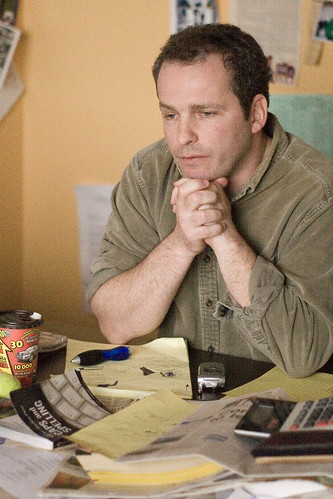 Managing editors wear many hats, god knows. But one of them should not be appearing as a speaker – make that cheerleader – at an emotionally-charged political event.
 It is my view that Ryan Cleary (right, photo by Duncan De Young/The Muse) made such a mistake, by speaking at the Stand Up For Newfoundland & Labrador political demonstration Friday at Confederation Building.
I was also disappointed - though less so - that Randy Simms, host of VOCM’s Open Line, was emcee for the event. It is fine for Simms to offer political analysis on ‘Here & Now’, but hosting a political rally is something altogether different. However, Simms does an admirable job of staying unbiased during Open Line, and I’ve even heard him play devil’s advocate against causes he apparently believes in. So I am willing to forgive him this momentary lapse.
Cleary’s case is different. He is not a traffic cop on a call-in show; he decides what does and doesn’t get printed in a newspaper that some see as influential.
The Independent is often compared to the now defunct Sunday Express (where I worked) because the latter was controversial and nicely designed. But that is where the similarities end.
The Sunday Express was a newspaper that broke more than a dozen stories every week, whereas The Independent might break one or two. The Sunday Express was an objective newspaper that carried a brief for no one, whereas The Independent is a propaganda sheet that has become a cheerleader for the Williams government and Newfoundland nationalists.
I am not the only individual to question Ryan Cleary’s judgment on appearing at this event. CBC Radio Noon host John Furlong raised exactly this point with Cleary, in a live interview via cell phone from Friday’s event. Here’s an excerpt:
Furlong: Ryan, what about your role as a journalist? Are you worried that you are compromising your impartiality by taking a stand?
Cleary: You know, you asked me that question earlier this morning John, and the first thought that ran through my head was, ‘I wonder, did you ask that question to David Cochrane when he appeared before the Board of Trade, or Craig Westcott, when he gave a speech a while ago to the offshore oil (industry)?’
Furlong: Well, David Cochrane analyzed the political climate. He didn’t take a stand on a public issue. And he was invited to speak. There’s a big difference.
Cleary: Well, I don’t see that as a big difference. I’m here as a Newfoundlander…
But here is what Cleary said in the same interview, just two minutes before that:
I’m here today basically as the Editor In Chief of The Independent, but I am also here I guess primarily as a Newfoundlander and Labradorian first.
Thanks for, um, clarifying that.
Like a politician, Cleary dodges Furlong’s questions about impartiality, bridging immediately from the sticky subject of ethics over to the ‘rah rah Newfoundland and Labrador’ line, just as a politician would. In fact, Cleary’s speech overflowed with political rhetoric and bombast. (The full text was published as Cleary’s column in Friday’s Independent, and is posted at their web site .)
The paper’s nationalist stance is widely known and understood, despite Cleary’s occasional half-hearted denials. Just a few weeks ago, on April 20, Cleary reaffirmed this in his column. He was commenting on a guest column by political science professor Michael Temelini, who advocates “opening a discussion” about separating from Canada.
“(Temelini) says there’s nothing wrong with asking whether there’s a better way. True, but people are afraid; they feel threatened. I say Newfoundlanders and Labradorians must finally face their fears.”
Cleary closes that column by saying that the “the bigger dragon to slay will be the media,” a suggestion perhaps that other media aren’t giving separation the attention it deserves. What the other media aren’t doing is selling out their credibility by pumping their fists in the air at political rallies, or wedging their noses firmly – if figuratively – between the nether cheeks of our premier.
In the above noted column, Cleary wrote that: “I do not stand before you to cheerlead for Premier Danny Williams, although I do walk beside him in his quest to push this place forward.”
Look at the fawning treatment the paper gave Premier Williams last week, by printing verbatim his entire speech to the Economic Club of Toronto, without a shred of analysis or commentary, except to say that the Premier “set the record straight” about Newfoundland and Labrador.
Michael Harris, the Editor-In-Chief of The Sunday Express, was quick to praise Premier Clyde Wells if he supported his stand on a particular issue. But Harris kept this praise confined to editorials, didn’t let it filter into the news pages and would never, ever have stumped for a premier at a political rally.
Maybe Cleary is planning to run for provincial or federal politics, or perhaps land a job in the Premier’s office. He has every right to do so. And it is not against the law to turn what could have been a decent newspaper into a political manifesto.
However, it does cause problems for the journalists who work under him. The columnists are somewhat insulated from this, since they bring subjectivity to the mix, but the reporters need to be objective – and perceived as objective. How can they claim this when the paper itself is so obviously biased against all things ‘Canada’? When their Editor In Chief is out stumping for the premier?
The Independent has some good reporters on staff (though they could be breaking more stories), and some decent columnists. The back section is fabulous, as is some of the intellectual ferment on the opinion pages (to their credit, the paper does publish letters that question its nationalist stance or criticize the premier). Where it falls down is its blatant nationalist agenda, which was lampooned nicely by the Muse a while ago when it wrote "NL gets raw deal, See story every page". Even fans of the newspaper will agree that this bias is there – it’s why they read the paper. But do they trust it to deliver objective reporting?
No, The Independent is not impartial.
It is not even ‘independent’.
It is propaganda.
Thursday, February 22, 2007
The Independent threatened to sue blogger
Last week, Anne Budgell of CBC Radio Noon interviewed blogger Ed Hollett, asking him how it felt to be singled out by the Premier as the possible target of a libel suit. During the Interview, Hollett mentioned that some time ago a local newspaper had also threatened to sue him.
This was something of a shock. Newspapers are commonly the target of lawsuits, but rarely the aggressor. Hollett has been known to write an unkind word or two about The Independent, and was quick to confirm my suspicion when I called him.
The letter was received quite some time ago and Hollett didn’t have it as his fingertips when I called. He did say that the letter asked him to stop making any further reference to the newspaper in his blog.
I then emailed Ryan Cleary, editor of The Independent, to get his side of the story. After all, The Independent is an opinionated newspaper that could not survive without freedom of speech, so it seems unusual to threaten legal action against someone else for exercising that right.
Cleary replied by saying that he didn’t want to be quoted in my blog, adding that he had no idea what I was talking about regarding a letter to Hollett. “If it happened, it wasn't while I was at the helm of The Independent,” he wrote.
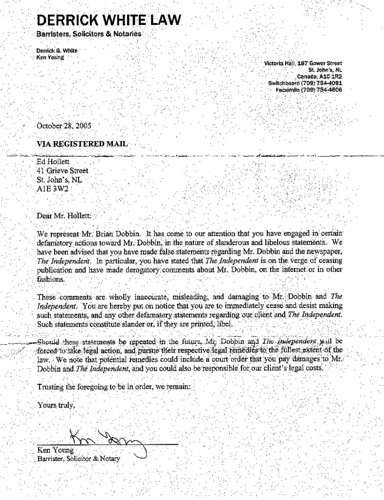
For clarification, I went back to Hollett, who delved into his files, retrieved the letter, and sent over a scanned copy. The letter, dated October 28 2005, is from Ken Young of Derrick White Law, speaking on behalf of his client, Brian Dobbin (at the time, the owner of The Independent). It claims that Hollett made false statements about Dobbin and the newspaper, including speculation that the newspaper was on the verge of ceasing publication
“These comments are wholly inaccurate, misleading and damaging to Mr. Dobbin and The Independent,” the letter reads. “You are hereby put on notice that you are to immediately cease and desist making such statements, and any other defamatory statements regarding our client and The Independent… Should these statements be repeated in the future, Mr. Dobbin and The Independent will be forced to take legal action, and pursue their respective legal remedies to the fullest extent of the law.”
What do I make of all this? Well, as noted, I do think it’s ridiculous for a scrappy paper like The Independent to sue others for expressing alternative points of view. I appreciate that printing rumours about imminent closure can be harmful. I am more concerned about the “other defamatory statements” since these qualify as fair comment, no matter how critical they may have been. I would hope that the paper will cease and desist from such drastic measures in the future.
That said, I take Cleary at his word on this. I really don’t think he knew what Dobbin was doing, since the lawyer is clearly acting on Dobbin’s behalf.
And what did Ed Hollett do? At the time, he did cease and desist, though he continues to mention the paper occasionally.
“I just decided that it was not worth the crap,” Hollett said. “If I had my time back, I would have kept it up to see if they put their money where their mouth was.”
Saturday, February 10, 2007
When privacy and accountability collide (Dec 2005)
Privacy legislation has shut down public accountability in this province and clear across the country.
The issue has been festering like a boil on the back of journalists for some time now. And last week, in a fit of frustration, Ted Blades of CBC Radio ‘On the Go’ stuck a pin in it.
It was a textbook example of what typically happens in cases like this. The reporter presents the person who is accountable – either a public servant or minister – with powerful testimony, usually from a family member, detailing a failure in the system and the painful consequences for those involved.
However, rather than explain what went wrong, the person responsible says, “We don’t comment on specific cases for privacy reasons.”
In this instance, it was the removal of a four-year-old Innu boy from the home of his foster parents, Paul and Jane Tulk, to be sent back to his home community of Sheshatshiu. The reason for the move – to enable the boy to grow up in his own culture – was valid, but it was handled in a hamfisted manner that was cruel to the foster parents and probably traumatic for the boy.
When Ted Blades tried to question Ivy Burt, Director of Child and Youth Services for the province, he received the standard reply: “I can’t speak to the specifics of this case.” He continued to probe, growing increasingly frustrated by her steadfast refusal to comment.
When he raised the foster parents’ complaint that the social workers arrived to take the child without a child safety seat, the reply was, “I can’t comment specifically on that specific case or answer that question.”
Now, is it just me, or does that sound like nonsense to you? Rather than assure us that the child’s basic safety needs were met, which in no way compromises privacy, it would seem that she dodged a potentially embarrassing question by hiding behind the cloak of confidentiality.
“The Tulks are willing to talk about this and clearly have concerns – why can’t you talk to the specifics of this case?” Blades asked. Again, same answer: “Not our policy to speak about specific children in the media…”
“As the media, we run into this every time we want to do a story involving Social Services,” Blades continued. “But that leaves a lot of our listeners frustrated. It means there is a sheet that you can hide behind; that the department, the people in the field and you are not accountable. If you can’t talk about it in public, how does accountability happen?”
Ms. Burt’s answer was that accountability can happen internally (as it did, no doubt, when Social Services was managing the Mount Cashel file) and through the office of the Child and Youth Advocate, which is a fair point. (I tried to interview Darlene Neville, the province’s Child and Youth Advocate, but we played phone tag and failed to connect.)
Ryan Cleary is Managing Editor of The Independent and a seasoned investigative reporter. He agrees that privacy concerns are stifling public accountability. “I have run into that on numerous occasions, where you have a specific story, you go to a department for comment on that story and they will say ‘No we do not respond to individual cases’ and then talk in generalities. It’s a way out. When they don’t comment on a specific story, it takes away from the legitimacy of the story. It takes away from how hard-hitting the story is. It’s kind of left hanging.
“At the same time, they do have a point,” Cleary added, acknowledging that privacy is a right that must be addressed. However, he agreed that the legislation needs to be revisited and adjustments made to increase public accountability.
“If you have a person who comes out on the record, they agree to have their name publicized and have their picture taken… if they are willing to go that far, well then the department should meet you the other half of the way and comment on specific cases. Now if the person doesn’t want to use their name, wants to remain anonymous, then why should the department comment?”
Rod Etheridge, a producer / reporter with CBC Radio, also ran into this wall last week. He was reporting on the case of a five-year-old child who was bullied and sexually assaulted by another child at a school in St. John’s. Etheridge said he understood the child’s right to privacy, but was puzzled by the refusal of Darin King of the Eastern School District to discuss how the case was handled. For example, the mother claimed that only a handful of teachers had been informed of the situation, and she felt that every teacher in the school should be made aware of it.
“He said it’s a private, confidential issue and was very disappointed that CBC would talk about it on the public airwaves,” Etheridge said. “I said that this woman gave us permission to talk about it, and he still argued that it was not a public issue. I asked if he would inform the teachers or the parents (of what happened), and he said they had told the people who needed to know, and the agencies involved. His argument was this: If there are 10 or 15 kids involved in this incident, how would you feel if you were a parent and heard your son talked about on the radio? I said ‘let me challenge that’ and said ‘what if you were a parent of a kid in the school – wouldn’t you want to know that this was going on?’ But he maintained that it’s a private, confidential issue, even if the mother gives permission for it to be discussed.”
Etheridge said the director would not disclose whether or not other teachers had been informed or if Family Services had been called in. “I don’t understand why all the people who needed to know – including the parents of children in that school – wouldn’t be informed. How do you make the decision of who does and doesn’t get told? It was nothing – just no comment at all on that case.”
Kim Kielley of The Express has been reporting on – make that attempting to report on – the case of the person with schizophrenia who is living in the woods on the fringes of Mount Pearl. It’s a difficult case because the man is refusing assistance, and likely will continue to do so because he is not receiving medication.
“For privacy reasons the department refuses to speak about this case, yet this guy is out in the woods, unmedicated and the situation is not being resolved… He could be dead by now.”
Kielley said she is receiving no information on the case from provincial officials, who refuse to comment for privacy reasons. “The only reason I know he has schizophrenia and is paranoid is because I had to call Alberta and track his brother down. And that’s outside of the province. That’s unacceptable. The department has an obligation to look after this person and even when they’re confronted in the House they still say they can’t discuss the case.”
It’s complicated because the man in the woods is not willing to discuss his case. In order to save his life, he will need to be arrested against his will (which is a possibility, since the man allegedly threatened to injure a rabbit hunter). Meanwhile, the bureaucratic logjam continues and the situation is unresolved. Public debate on this issue would likely move government to action before the individual freezes to death in the woods. Which begs the question: will they refuse to comment on specific cases even after the individual has died? This is not a minor issue. Sometimes the question of privacy versus accountability is a matter of life and death.
“From my standpoint it’s frustrating as hell because I am trying to get information and I almost get the impression that different departments are hiding behind the legislation,” Kielley said. “They say we can’t discuss individual cases because of privacy, but if you don’t discuss it then really there’s nothing to talk about… Obviously the legislation has to change.”
Kielley says she doubts that accountable individuals have actually read the privacy legislation. “Really, I don’t think they know enough about it. I don’t know enough about it. And the people who are using it as an excuse, I don’t think are very well versed in it.”
One person who is familiar with the legislation is Russell Wangersky, Managing Editor of The Telegram. Wangersky’s opinion is that two different pieces of legislation – at the federal and provincial levels – work together to severely constrain the ability of those accountable to comment on specific issues. In other words, they are justified in not commenting.
“The federal privacy legislation is pretty darn strict and there’s the privacy component to the new ATIPA (provincial Access to Information and Privacy Act) as well,” he said, agreeing that there is no ‘wiggle room’ at all between the two pieces of legislation. “And it’s bad for the system, because… when someone feels hard-done-by, it’s really hard to get their concerns addressed in the media… I think it is certainly being used as a crutch.”
Wangersky pointed out that there are two sides to every story, and that the individuals and institutions who are bound by privacy legislation are sometimes at a disadvantage because they cannot defend themselves or let outlandish accusations go unchallenged. “Not everybody who is making a complaint (is necessarily telling the truth)… We had a situation with someone who came back to us after the fact and said, ‘Look, we wish we had a mechanism where we could talk to you about this particular individual because what he said to you on the record is not true.’ In this instance the institution felt quite hard done by.”
Jerry Vink, the Director of the Newfoundland-Labrador Human Rights Association, has some strong opinions on this issue which are diametrically opposed to the views you’ve read thus far. He is adamant about the need to protect the privacy of individuals, especially children, and agrees that specific details of any case should not be discussed in public.
However, this is a column, not a news story, so I was free to engage Jerry in a wide-ranging debate. I fired several scenarios at him, such as what happens when the person most affected by circumstances cannot engage in public discourse about those circumstances, due to his own so-called privacy. To his credit, Vink showed flexibility.
“Privacy issues, much like other human rights issues, are usually a case of balancing two sets of rights,” Vink said. “That’s what makes it challenging… between the right to privacy and the right to accountability, we haven’t found the balance yet. It’s going to be an interesting debate as time goes on.”
Vink did agree that there is room to take another look at the legislation. “I think it is quite correct to say that since we are in some ways redefining privacy at this time, and because we are dealing with balancing, it is always appropriate to think through the legislation and operating procedures that we use when dealing with privacy. We have to continuously change as time goes by… I have no problem with re-examining the legislation and the operating procedures that are used.”
And there you have it. When one of the most staunch defenders of human rights in the province allows that there is room for change, there is no choice but to throw the door open and push through. Journalists have to put objectivity aside and take a stand on this issue. It is fundamental to free speech and critical to the future of journalism itself.
I am not suggesting that this is some Machiavellian plot hatched by politicians to stifle the public’s right to know. I accept it is an unexpected outcome of the legislation. But that doesn’t make it right. The facts of the case are simple: if those accountable cannot comment on a specific case, then they can’t comment on any case, because every case is ‘specific’.
Both levels of government must revisit the legislation. They must fix this problem.
Our right to privacy must be balanced by our right to know.
The issue has been festering like a boil on the back of journalists for some time now. And last week, in a fit of frustration, Ted Blades of CBC Radio ‘On the Go’ stuck a pin in it.
It was a textbook example of what typically happens in cases like this. The reporter presents the person who is accountable – either a public servant or minister – with powerful testimony, usually from a family member, detailing a failure in the system and the painful consequences for those involved.
However, rather than explain what went wrong, the person responsible says, “We don’t comment on specific cases for privacy reasons.”
In this instance, it was the removal of a four-year-old Innu boy from the home of his foster parents, Paul and Jane Tulk, to be sent back to his home community of Sheshatshiu. The reason for the move – to enable the boy to grow up in his own culture – was valid, but it was handled in a hamfisted manner that was cruel to the foster parents and probably traumatic for the boy.
When Ted Blades tried to question Ivy Burt, Director of Child and Youth Services for the province, he received the standard reply: “I can’t speak to the specifics of this case.” He continued to probe, growing increasingly frustrated by her steadfast refusal to comment.
When he raised the foster parents’ complaint that the social workers arrived to take the child without a child safety seat, the reply was, “I can’t comment specifically on that specific case or answer that question.”
Now, is it just me, or does that sound like nonsense to you? Rather than assure us that the child’s basic safety needs were met, which in no way compromises privacy, it would seem that she dodged a potentially embarrassing question by hiding behind the cloak of confidentiality.
“The Tulks are willing to talk about this and clearly have concerns – why can’t you talk to the specifics of this case?” Blades asked. Again, same answer: “Not our policy to speak about specific children in the media…”
“As the media, we run into this every time we want to do a story involving Social Services,” Blades continued. “But that leaves a lot of our listeners frustrated. It means there is a sheet that you can hide behind; that the department, the people in the field and you are not accountable. If you can’t talk about it in public, how does accountability happen?”
Ms. Burt’s answer was that accountability can happen internally (as it did, no doubt, when Social Services was managing the Mount Cashel file) and through the office of the Child and Youth Advocate, which is a fair point. (I tried to interview Darlene Neville, the province’s Child and Youth Advocate, but we played phone tag and failed to connect.)
Ryan Cleary is Managing Editor of The Independent and a seasoned investigative reporter. He agrees that privacy concerns are stifling public accountability. “I have run into that on numerous occasions, where you have a specific story, you go to a department for comment on that story and they will say ‘No we do not respond to individual cases’ and then talk in generalities. It’s a way out. When they don’t comment on a specific story, it takes away from the legitimacy of the story. It takes away from how hard-hitting the story is. It’s kind of left hanging.
“At the same time, they do have a point,” Cleary added, acknowledging that privacy is a right that must be addressed. However, he agreed that the legislation needs to be revisited and adjustments made to increase public accountability.
“If you have a person who comes out on the record, they agree to have their name publicized and have their picture taken… if they are willing to go that far, well then the department should meet you the other half of the way and comment on specific cases. Now if the person doesn’t want to use their name, wants to remain anonymous, then why should the department comment?”
Rod Etheridge, a producer / reporter with CBC Radio, also ran into this wall last week. He was reporting on the case of a five-year-old child who was bullied and sexually assaulted by another child at a school in St. John’s. Etheridge said he understood the child’s right to privacy, but was puzzled by the refusal of Darin King of the Eastern School District to discuss how the case was handled. For example, the mother claimed that only a handful of teachers had been informed of the situation, and she felt that every teacher in the school should be made aware of it.
“He said it’s a private, confidential issue and was very disappointed that CBC would talk about it on the public airwaves,” Etheridge said. “I said that this woman gave us permission to talk about it, and he still argued that it was not a public issue. I asked if he would inform the teachers or the parents (of what happened), and he said they had told the people who needed to know, and the agencies involved. His argument was this: If there are 10 or 15 kids involved in this incident, how would you feel if you were a parent and heard your son talked about on the radio? I said ‘let me challenge that’ and said ‘what if you were a parent of a kid in the school – wouldn’t you want to know that this was going on?’ But he maintained that it’s a private, confidential issue, even if the mother gives permission for it to be discussed.”
Etheridge said the director would not disclose whether or not other teachers had been informed or if Family Services had been called in. “I don’t understand why all the people who needed to know – including the parents of children in that school – wouldn’t be informed. How do you make the decision of who does and doesn’t get told? It was nothing – just no comment at all on that case.”
Kim Kielley of The Express has been reporting on – make that attempting to report on – the case of the person with schizophrenia who is living in the woods on the fringes of Mount Pearl. It’s a difficult case because the man is refusing assistance, and likely will continue to do so because he is not receiving medication.
“For privacy reasons the department refuses to speak about this case, yet this guy is out in the woods, unmedicated and the situation is not being resolved… He could be dead by now.”
Kielley said she is receiving no information on the case from provincial officials, who refuse to comment for privacy reasons. “The only reason I know he has schizophrenia and is paranoid is because I had to call Alberta and track his brother down. And that’s outside of the province. That’s unacceptable. The department has an obligation to look after this person and even when they’re confronted in the House they still say they can’t discuss the case.”
It’s complicated because the man in the woods is not willing to discuss his case. In order to save his life, he will need to be arrested against his will (which is a possibility, since the man allegedly threatened to injure a rabbit hunter). Meanwhile, the bureaucratic logjam continues and the situation is unresolved. Public debate on this issue would likely move government to action before the individual freezes to death in the woods. Which begs the question: will they refuse to comment on specific cases even after the individual has died? This is not a minor issue. Sometimes the question of privacy versus accountability is a matter of life and death.
“From my standpoint it’s frustrating as hell because I am trying to get information and I almost get the impression that different departments are hiding behind the legislation,” Kielley said. “They say we can’t discuss individual cases because of privacy, but if you don’t discuss it then really there’s nothing to talk about… Obviously the legislation has to change.”
Kielley says she doubts that accountable individuals have actually read the privacy legislation. “Really, I don’t think they know enough about it. I don’t know enough about it. And the people who are using it as an excuse, I don’t think are very well versed in it.”
One person who is familiar with the legislation is Russell Wangersky, Managing Editor of The Telegram. Wangersky’s opinion is that two different pieces of legislation – at the federal and provincial levels – work together to severely constrain the ability of those accountable to comment on specific issues. In other words, they are justified in not commenting.
“The federal privacy legislation is pretty darn strict and there’s the privacy component to the new ATIPA (provincial Access to Information and Privacy Act) as well,” he said, agreeing that there is no ‘wiggle room’ at all between the two pieces of legislation. “And it’s bad for the system, because… when someone feels hard-done-by, it’s really hard to get their concerns addressed in the media… I think it is certainly being used as a crutch.”
Wangersky pointed out that there are two sides to every story, and that the individuals and institutions who are bound by privacy legislation are sometimes at a disadvantage because they cannot defend themselves or let outlandish accusations go unchallenged. “Not everybody who is making a complaint (is necessarily telling the truth)… We had a situation with someone who came back to us after the fact and said, ‘Look, we wish we had a mechanism where we could talk to you about this particular individual because what he said to you on the record is not true.’ In this instance the institution felt quite hard done by.”
Jerry Vink, the Director of the Newfoundland-Labrador Human Rights Association, has some strong opinions on this issue which are diametrically opposed to the views you’ve read thus far. He is adamant about the need to protect the privacy of individuals, especially children, and agrees that specific details of any case should not be discussed in public.
However, this is a column, not a news story, so I was free to engage Jerry in a wide-ranging debate. I fired several scenarios at him, such as what happens when the person most affected by circumstances cannot engage in public discourse about those circumstances, due to his own so-called privacy. To his credit, Vink showed flexibility.
“Privacy issues, much like other human rights issues, are usually a case of balancing two sets of rights,” Vink said. “That’s what makes it challenging… between the right to privacy and the right to accountability, we haven’t found the balance yet. It’s going to be an interesting debate as time goes on.”
Vink did agree that there is room to take another look at the legislation. “I think it is quite correct to say that since we are in some ways redefining privacy at this time, and because we are dealing with balancing, it is always appropriate to think through the legislation and operating procedures that we use when dealing with privacy. We have to continuously change as time goes by… I have no problem with re-examining the legislation and the operating procedures that are used.”
And there you have it. When one of the most staunch defenders of human rights in the province allows that there is room for change, there is no choice but to throw the door open and push through. Journalists have to put objectivity aside and take a stand on this issue. It is fundamental to free speech and critical to the future of journalism itself.
I am not suggesting that this is some Machiavellian plot hatched by politicians to stifle the public’s right to know. I accept it is an unexpected outcome of the legislation. But that doesn’t make it right. The facts of the case are simple: if those accountable cannot comment on a specific case, then they can’t comment on any case, because every case is ‘specific’.
Both levels of government must revisit the legislation. They must fix this problem.
Our right to privacy must be balanced by our right to know.
Subscribe to:
Posts (Atom)


